Work backwards from the registration desks
Ask the event lead where the books will be opened and who can read each language. A single delivery address does not mean a single destination inside the venue. If books for two desks arrive loose in one box, someone at the dock inherits a sorting job.
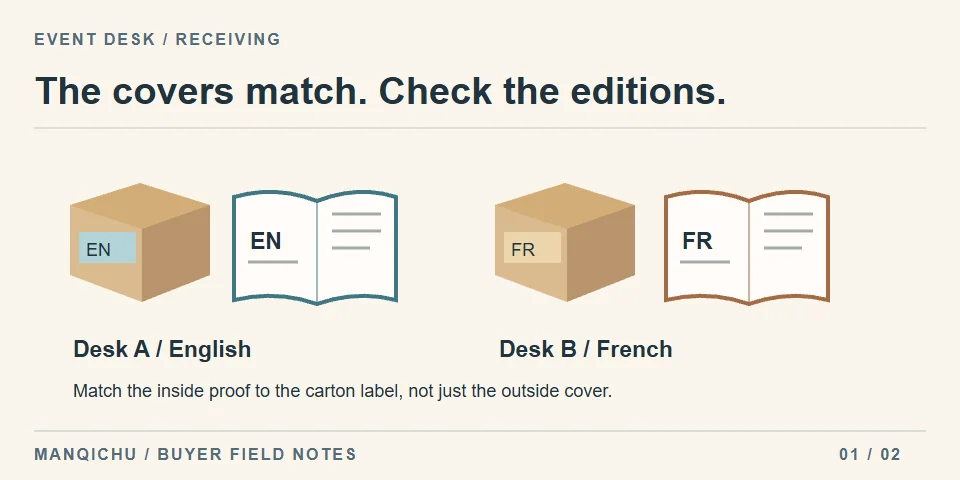
Define an edition by the actual print file. For example, EN-R3 and FR-R2 may share the same cover but use different schedules inside. Put the code on the packing list and carton label. If it can be printed discreetly inside the book, agree on the position before approving the proof. A colour sticker alone is a weak identifier.
- Edition key
- Give each approved interior file a short code independent of the cover artwork.
- Partial carton
- Record the actual count beside the edition code, not just the nominal carton capacity.
- Receiving
- Open a sample book at the agreed page and match its language to the carton label.
Why 300 notebooks may need thirteen cartons, not twelve
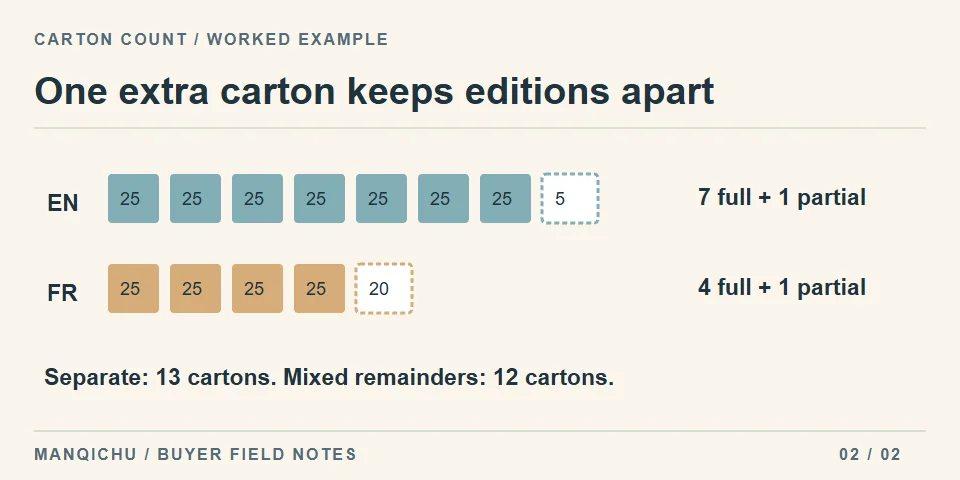
Illustrative event order: 180 English books and 120 French books. Assume the packer confirms 25 books fit in each carton. English needs seven full cartons and one carton of five. French needs four full cartons and one carton of twenty. That is thirteen cartons kept separate, versus twelve if the last five and twenty are packed together.
The mixed option saves one outer carton, not necessarily one carton's worth of freight. Ask for the two actual packed quotations. Then ask whether the dock can open one clearly marked split carton without breaking a delivery seal or separating an unlabelled stack from its destination. If not, take the thirteenth carton.
Give the packer one line per physical carton
A useful label for the English remainder is EN-R3 / Desk A / 5 books / carton 8 of 8 for this edition. Do not preprint 25 on every label. If mixing is authorised, list both edition counts on the outside and label each inner bundle before sealing.
Ask for an open-carton photo of the partials with their labels visible. Verify that the cover image in the photo is not the only identifier. In this example an A5 lined journal is a reference for format, not a promise that a particular notebook can be supplied with printed interiors. Have the supplier confirm each interior, proof and edition minimum in writing.
Check the print file, not just the grand total
At receiving, agree a sampling plan with the supplier. Include each language and the partial or mixed cartons. Open a book to a page that differs between versions; compare its language and revision to the signed proof. Record a wrong edition separately from a shortage. Reordering a missing French carton does not correct an English book bound with obsolete pages.
Give registration staff the edition tally before distribution. A stock count of 300 can balance even if one desk is twenty books short. Retain the carton ID, the inside-page photo and the destination against any discrepancy.
Edition carton planner and packing brief
Try your edition quantities in the planner. Copy or download the blank brief below and name the desk that receives each edition.
Plan cartons by edition
Event / venue / receiving contact: ___
Edition A: file + revision ___ | desk ___ | copies ___
Edition B: file + revision ___ | desk ___ | copies ___
Supplier-confirmed packed capacity ___ books per carton
Full and partial carton counts by edition: ___
Mixed carton allowed? ___ | Inner labels and person splitting it: ___
Proof page to check: ___ | Discrepancy contact: ___
Return the carton list with actual contents, destination, dimensions, gross weight and separate/mixed freight quotes.
Related reading
Ask before packing
Can you show exactly which carton carries each partial edition and send the label beside the corresponding inside-page proof?