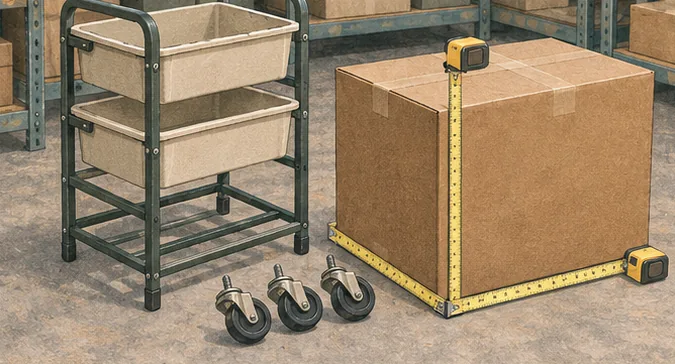
Ask what is inside one sealed shipping carton
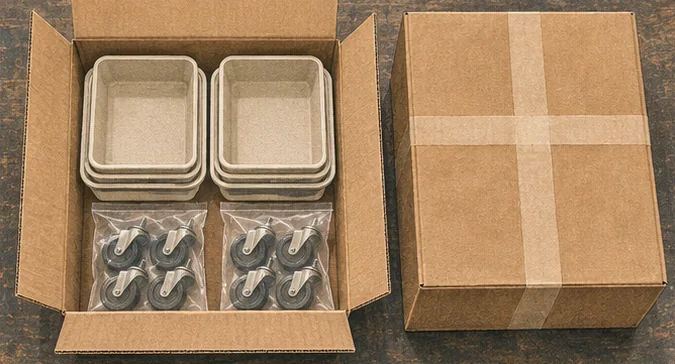
Two suppliers quote a rolling kitchen cart. The assembled height and shelf count match, but one price is for loose trays, posts and wheels, and the other is for a cart ready to roll. Before comparing either price, ask each supplier to photograph an open master carton and list its contents. Is there one complete cart in the box, several individually boxed carts, or a batch of trays with a separate hardware carton?
Count complete sellable units, not pieces. If ten sets of trays need ten bags of wheels and only nine bags arrive, the shipment contains at most nine complete carts until the missing bag is supplied. Ask for the part count per cart and the carton numbers that contain the hardware. For nested trays, check that a separator protects the visible finish and that the buyer can separate the trays without tools.
- 48 carts
- In the worked example, twelve full cartons hold four carts each.
- Last pair
- Ask whether the two remaining units use a full-size box.
- Shipment
- Add the actual thirteenth carton rather than pricing 12.5 boxes.
Work from outside measurements, including the partial carton
Request the closed master carton’s outside length, width and height, in the same unit, after tape and corner protection are applied. For centimetres, multiply length by width by height and divide by 1,000,000 to get cubic metres. Multiply by the number of cartons of that size, then add the totals for each carton type. Do not divide by units per carton twice.
Worked example only, not specifications or a freight quote: a buyer wants 50 carts. A flat-pack offer fits four per 60 × 40 × 40 cm carton. Twelve full cartons hold 48 carts. If the final two use the same outer carton, all 13 occupy 1.248 m³. If the supplier confirms a 60 × 40 × 20 cm partial carton instead, the total becomes 1.200 m³. The difference comes from one box, not a change in the cart.
Ask whether the forwarder needs palletised dimensions rather than loose-carton cube. A pallet overhang or a no-stacking instruction can change the transport quote. Gross weight matters too. Give the forwarder the same route, delivery point and handover terms for both offers; do not convert cube directly to a freight price.
Put an assembly cost next to the freight saving
Time one person assembling a sample with the tools actually available at your receiving site. Start with a sealed carton and stop when the wheels are seated, shelves are level and the packaging has been cleared. Note any step that needs a second person. Repeat with another unit before using the time in a budget; a first attempt can include time spent deciphering the instructions.
For illustration, six minutes per cart at a receiving labour rate of USD 18 per hour adds USD 1.80 per cart, or USD 90 for 50 carts. If the flat-pack freight saving is only USD 70 for that shipment, it does not cover this assembly cost. Substitute your own timed result and labour rate, and include any local repacking needed before dispatch.
Tie the price to a packing revision
Keep the approved carton photograph, outside dimensions, gross weight and contents list under one reference on the purchase order. Ask for a revised pack-out before accepting a change of wheel type, shelf count, retail sleeve or carton strength. Each can change the way the parts fit even when the catalogue photograph looks the same.
At receiving, pick a carton of each declared type, including the partial carton. Match its label to the packing list, count complete kits and assemble one of each configuration. Record shortages by carton number rather than signing off against the total piece count alone.
Copy the cart pack-out RFQ
Send the same request to both suppliers. Leave an unknown blank rather than treating it as zero.
Subject: Rolling storage cart quote — packing and freight comparison
Catalogue link / model / finish:
Quantity / destination postal code / required delivery point:
Quote currency, handover terms and named place:
Please price assembled and flat-pack separately where available.
For EACH carton type, including the last partial box:
- Number of cartons / outside L × W × H (cm) / gross kg per carton:
- Complete cart sets per carton, or trays / posts / wheels / fixings per carton:
- Retail cartons, separators and corner protection included:
- Is hardware packed separately? Give carton numbers and quantities:
- Pallet count, loaded dimensions, gross weight and stacking limits if palletised:
Please attach a sealed-box measurement photo, an open-box photo and the packing list.
Assembly steps / tools supplied or required:
Unit price / packing charge / freight / any excluded charges:
Sample packing revision / quote validity:
Related reading
Request the actual packed dimensions
Ask for outer carton length, width and height, gross weight and units per carton for each packing option. Confirm the dimensions are for the shipping carton, not the assembled cart.