Give the supplier the journey, not just the logo file
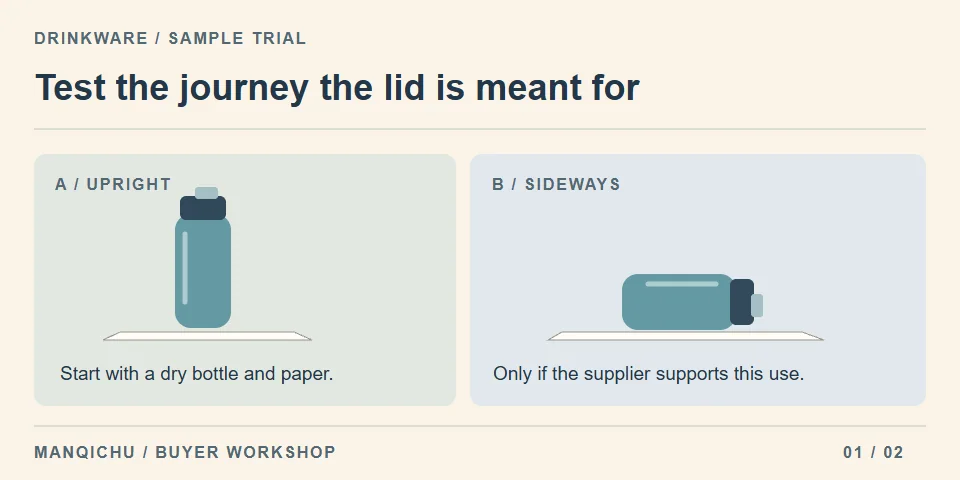
Write a one-line use brief for each recipient group. Desk staff may keep bottles upright and want a one-handed sip. Staff who commute by bike may carry a bottle sideways beside spare clothing. Ask the supplier whether that orientation is supported. Do not treat a visible drinking closure as a bag-safe claim.
For a flip-straw sample, ask which components are removable for routine cleaning and which should stay assembled. The linked vacuum sports bottle is an example of the lid style, not a statement about leak resistance, dishwasher use or suitability for hot drinks. Obtain model-specific instructions.
- Identity
- Record the body, lid and gasket revision; identify the sample you actually tested.
- Transport
- Record orientation, duration, fill level and moisture location under agreed conditions.
- Cleaning
- Check that the intended user can dismantle, dry and reassemble only the removable parts.
Use dry paper to locate the first wet point
Label the two complete samples A and B and start with dry exteriors. For a simple comparison, agree to use room-temperature still water, the same measured fill and an empty washable tray. Only use configurations the supplier permits. Close each lid as instructed, place fresh dry paper under the relevant contact area and record orientation and elapsed time. Do not test inside a bag containing a phone or laptop.
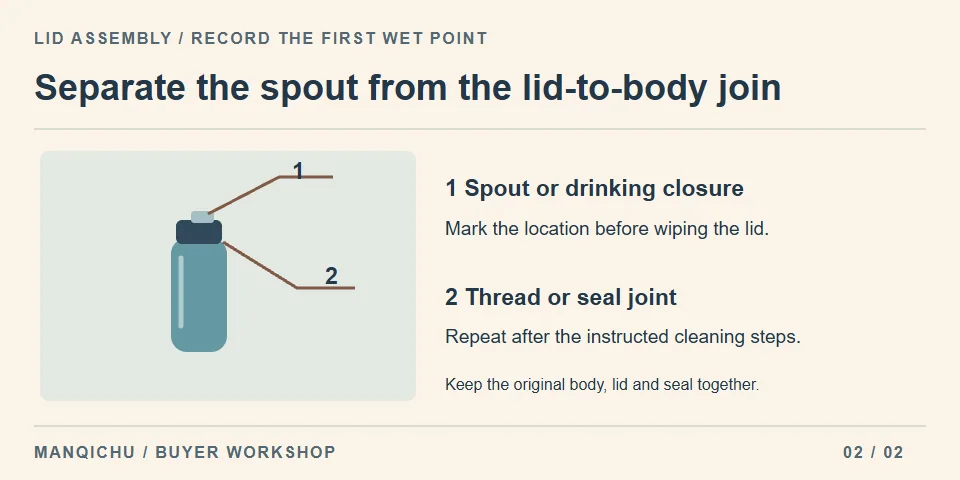
Example record, not a factory result: a buyer specifies 15 minutes upright, then 10 minutes on the side for lids explicitly offered for that use. At each change use fresh paper; note whether moisture first appeared at the spout, the lid-to-body join or nowhere visible. If the cap was already wet from filling, repeat from a dry start rather than reporting a leak. These short observations are not certification or a guarantee for all-day use.
Ask a second person to put the lid back together
After the carry trial, use the supplied cleaning instructions. Lay out only the parts meant to come off. A second person who did not dismantle the lid should try the stated reassembly steps. Can they tell which way the seal sits and whether the straw is fully seated? Record time and uncertainty rather than averaging two very different experiences.
Repeat the same carry check after reassembly. If a lid passes before cleaning but not afterwards, keep both observations. Ask whether the instructions are missing a step, whether a part was damaged or whether the supplied gasket differs. Do not solve a problem by silently swapping the gasket from sample B.
Decide what disqualifies a lid before comparing prices
Suppose a buyer needs a lid for a mixed desk-and-commuter programme. Sample A is easiest to sip from, but the supplier describes it as upright-only. Remove it from the commuter shortlist without claiming it failed a leak test. It might still be the better choice for the desk group. Quote the two quantities separately and check whether doing that changes the logo minimum.
Retain the approved assembly and ask for a separate quote for replacement lids or seals. Get the pack quantity, compatibility reference and reorder minimum in writing. Record the artwork sign-off separately: a good imprint cannot rescue a lid that is unsuitable for the promised journey.
Side-by-side lid trial record
Copy or download the test record. Complete it once for each sample, including any configuration excluded by the supplier.
Employee use: desk / upright carrier / sideways travel: ___
Sample A or B: ___ | Body / lid / seal reference: ___
Supplier-supported orientation and liquid: ___ | Instructions revision: ___
Fill / temperature / closure method / initial exterior dry: ___
Orientation and duration: ___ | First moisture location or none visible: ___
Parts removed for cleaning: ___ | Reassembly difficulty: ___
Repeat after cleaning: ___ | Approved use or hold: ___
Replacement lid or seal code / pack quantity / MOQ: ___
Reviewer / date / retained sample ID: ___
Related reading
Before approving the lid
Which closed-carry orientations do you support for this exact lid, and can you supply the matching seal with the same cleaning instructions?