Start with the pen, not a photograph of a loose refill
Ask for a body and its working refill from the same proposed production version. If the body is sealed or intended to be disposable, stop: quote replacement pens rather than a case of refills nobody can install. For a twist pen, record the twist mechanism; the click-pen check below is a separate example.
A catalogue listing for a 1.0 mm metal ballpoint is useful for identifying the pen to discuss. It does not establish a refill standard. Ask for the refill code, the orientation of any spring and a side-on drawing of both ends. A name such as metal refill or a writing width is not a mating dimension.
- Geometry
- Compare tip-to-shoulder distance as well as overall length.
- Mechanism
- Test extension, locking and retraction in the assembled pen.
- Reorder
- Request the supplier's refill reference, pack quantity and substitution rule.
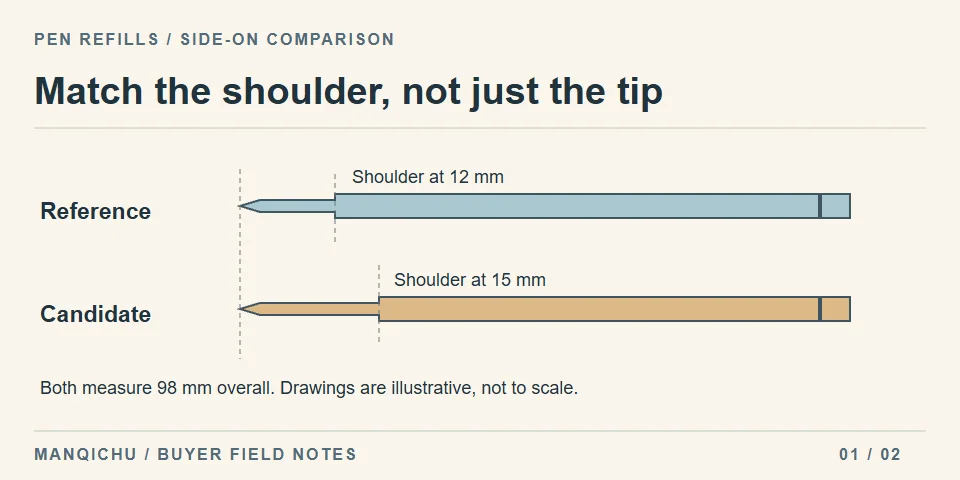
The 98 mm example: equal length, different seat
Illustrated example only: both refills measure 98 mm end to end and have the same writing width. On the approved one the shoulder starts 12 mm behind the tip. On the candidate it starts 15 mm behind it. The 3 mm difference changes where the shoulder can seat; it is not proof the point will extend 3 mm further. The spring and latch also affect the result.
Lay the parts parallel with their tips on the same line. Compare shoulder position, barrel diameter, rear profile and spring seating. Keep the original spring with the reference. Do not shorten a refill or swap springs until it works and then approve the unmodified part by mistake.
Test the whole writing cycle
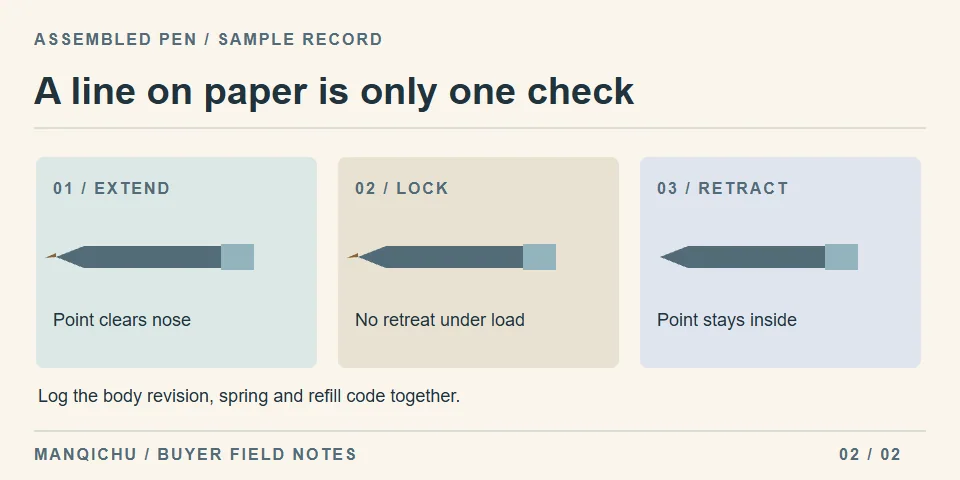
Install the proposed spare without force. Extend the point, write a short line on the intended paper, retract it, and check that it stays behind the nose. Repeat after opening and closing the body once more. Record the exact failure: will not lock, retracts under pressure, catches at the nose, or leaves ink on the pocket-facing end. A loose refill that writes is not a pass for the assembled pen.
For a worked buying decision, suppose a candidate passes the writing check but sticks extended in one sample body. Mark the refill/body combination on hold. Ask for the matching revision and repeat the mechanical test before pricing a large spare pack. This check does not establish ink life or shelf life; ask separately if either matters.
Make a spare-pack line that can actually be reordered
Ask the vendor to list the accepted body revision and refill code on one quote line, with ink colour, writing width, pieces per refill pack and pack minimum. Then compare cost per usable refill, not the price of an unspecified bag. A cheaper refill without a confirmed fit is a different offer.
Keep the accepted pen, one unused refill and the test record in a labelled envelope. For a repeat delivery, check the incoming part against that pair before opening the rest of the packs. If the manufacturer changes the rear plug or shoulder, ask for a new fit sample rather than accepting a matching tip size.
Pen and refill compatibility record
Copy or download this record. Complete a separate copy for each pen body and proposed replacement.
Pen SKU / body revision / mechanism: ___
Replaceable without damage? ___ | Supplier refill code: ___
Reference vs candidate (mm): overall length ___ / ___; tip to shoulder ___ / ___; barrel diameter ___ / ___
Rear plug / spring seat / spring used: ___
Assembled check: extends ___; locks ___; writes under pressure ___; retracts fully ___
Ink colour / writing width: ___ | Decision / sample ID / date: ___
Units per spare pack ___ | Pack MOQ ___ | Substitution requires new sample: ___
Related reading
Before ordering spares
Can you send one marked refill pack and the matching body revision so we can verify extension and retraction before approving the spare line?